



A rare disease is one that affects fewer than 1 in 2,000 people,[1] yet, since there are between 6,000 and 8,000 different rare diseases,[2, 3] they are collectively estimated to affect 1 in 17 people in the UK, at some point in their lives.[1] Around 80% of rare diseases have a genetic cause, and 70% start from childhood.[4] Rare diseases often present with a range of symptoms and can affect just one or a range of organs and systems in the body. The symptom burden is often vast with substantial impact on the patient, their families and the healthcare system. Some of the better-known rare diseases include sickle cell, cystic fibrosis, and haemophilia.
Gene therapies alter the genes inside human cells to prevent and treat disease, by replacing a disease-causing gene with a healthy copy, inactivating a disease-causing gene, or introducing a new gene to treat a disease.[5, 6] Gene therapies can be single dose with lifelong benefit, and often address high unmet need by providing a therapy for debilitating conditions where there are currently limited or no treatment options. In recent years more therapies have entered the market, however they typically come with very high list prices due to the technology involved in developing and administering them, and the rarity of the condition requiring high prices to recoup research and development costs. Furthermore, there are several hurdles to evidence generation in rare diseases, which often results in a certain extent of clinical uncertainty.[5, 7] This is further amplified with gene therapies where trials are often small, single-arm trials with novel or surrogate endpoints, as a result of accelerated regulatory routing.[8] Together, a high up-front price and inherent uncertainty in the long-term clinical efficacy and safety data, threaten the affordability and accessibility of these therapies,[5] and create challenges for health technology assessment bodies in assessing their cost-effectiveness. There is therefore a need for payers to generate a system where greater upfront cost can be balanced with potentially substantial patient and carer benefit but uncertain long-term clinical effectiveness.
Whilst the FDA defines gene therapy as a technique used to modify a person’s genes to treat or cure a disease,[9] the EMA defines gene therapy as those containing genes that lead to a therapeutic, prophylactic, or diagnostic effect.[10] The broader EMA definition more clearly permits inclusion of enzyme-replacement therapies, which introduce an additional, healthy copy of a gene into the cells, and are normally administered at regular intervals, long-term. For example, Strensiq replaces the alkaline phosphatase enzyme which people with paediatric onset hypophosphatasia are deficient in, and is administered 3-6 times per week, long-term.[11, 12] Arguably, such therapies are easier to appraise using traditional HTA processes and economic modelling, as they have similarities to traditional non-gene therapies; whereas the single-dose therapies pose additional challenges such as long-term clinical uncertainty of durability of response and large upfront costs. Both HTA bodies and academic/ industry experts alike have assessed methodologic questions associated with economic evaluation of gene therapies and suggest that some aspects need to be considered further due to the unique features of gene therapies.[5]
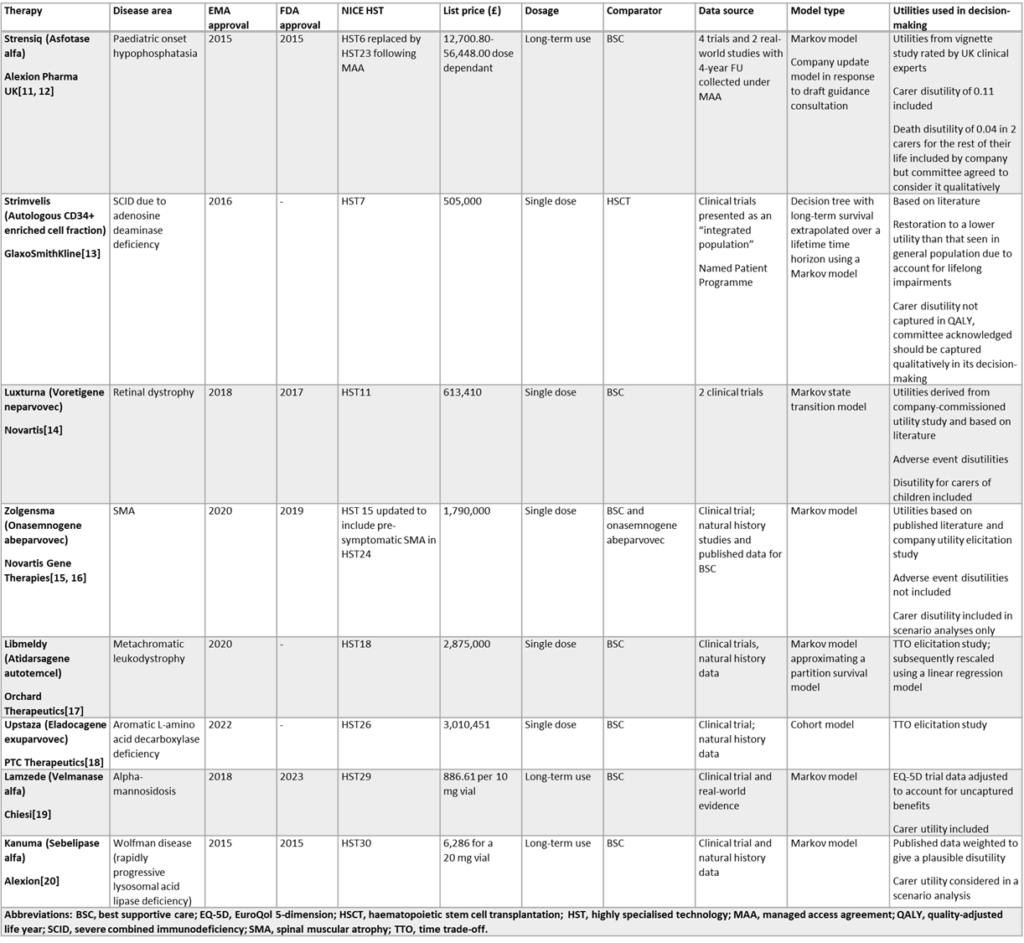
At NICE, the rarest diseases are appraised through the highly specialised technology (HST) route. To date, NICE has appraised eight gene therapies through the HST process (Table 1):
Strensiq for paediatric onset hypophosphatasia
Strimvelis for severe combined immunodeficiency (SCID)
Luxturna for retinal dystrophy
Zolgensma for spinal muscular atrophy (SMA)
Libmeldy for metachromatic leukodystrophy
Upstaza for aromatic L-amino acid decarboxylase deficiency
Lamzede for alpha-mannosidosis
Kanuma for Wolfman disease
Of these eight therapies, five were single-dose therapies (Strimvelis, Luxturna, Zolgensma, Libmeldy, Upstaza)[13-18] and three were enzyme replacement therapies with long-term dosages (Strensiq, Lamzede, Kanuma).[11, 12, 19, 20] Notably all eight gene therapies appraised through the NICE HST route, received positive recommendation. The single-dose therapies ranged in list price from £505,000 for Strimvelis to £3,010,451 for Upstaza, all with commercial discounts remaining commercial in confidence.
The long-term treatment effect of some single-dose technologies were often questioned during the appraisals, where it was commented that although the treatment effect was expected to last decades, the trial follow-up time was limited, thereby creating substantial uncertainty. One such example was HST11, Luxturna, for retinal dystrophy, where the trial evidence showed no loss of efficacy after 7.5 years of follow-up, but the economic evaluation assumed a treatment effect of 40-years. Given a lack of longer-term evidence and the clinical plausibility for long-term treatment effect, confirmed by clinical experts, the committee considered a 40-year duration “uncertain but reasonable”.[14]
Further uncertainty in the appraisals arose from single-arm trials often being the main source of clinical evidence, with comparator evidence provided by natural history studies or real-world evidence, collected inside or outside of managed access agreements. Most of these trials also did not collect EQ-5D-5L, the NICE-preferred preference-based instrument for measuring HRQoL. Some of the appraisals accounted for this by performing utility elicitation studies, however there was significant variation in how they were performed and how well the health states reflected key disease progression milestones, giving rise to unlikely utility estimates in some cases.[11, 12, 14-18]
Another consideration across many of the gene therapy appraisals was how best to incorporate carer disutility. In HST15/ 24 treatment with Zolgensma for SMA reduced carer burden in the short-term but prolonged life and therefore increased the total amount of caregiving required over a lifetime horizon, having an adverse impact on the ICER.[15, 16] This is often an issue where new treatments have large impacts on overall survival, and/ or where long-term impact on caregiver burden is uncertain, and will therefore likely be a consideration for many gene therapies.
This brief overview of prior NICE HST appraisals of gene therapies provides a snapshot of the potential issues faced by all invested parties during technology appraisals of gene products. It also demonstrates the array of products that “gene therapies” captures and the differences in costs and cost models between them. Notably, all eight treatments received positive recommendation from NICE, although the Patient Access Scheme (PAS) remains confidential, so it is not clear how much of a discount was agreed in order for the treatment to be considered cost-effective.
NICE have demonstrated proficiency to date in appraising a relatively small number of gene therapies in rare diseases that have been launched. However, by 2034 it is estimated that over 1 million people will be treated with gene therapies, in the US alone, costing in excess of $300 billion.[21] Alternative payment models may be adopted by some healthcare systems to address long-term uncertainty and reimbursement issues such as performance-based instalment payments, subscriptions, or expenditure caps.[22]
Table 1: Cell and gene therapies that have been appraised through NICE HST to date (9/4/2024)
References
Horrow, C. and A.S. Kesselheim, Confronting High Costs And Clinical Uncertainty: Innovative Payment Models For Gene Therapies. Health Affairs, 2023. 42(11).
GOV.UK. The UK Rare Diseases Framework. 2021 01/06/2022]; Available from: https://www.gov.uk/government/publications/uk-rare-diseases-framework/the-uk-rare-diseases-framework.
EuropeanCommission. EU research on rare diseases. 01/06/2022]; Available from: https://research-and-innovation.ec.europa.eu/research-area/health/rare-diseases.
Nestler-Parr, S., et al., Challenges in Research and Health Technology Assessment of Rare Disease Technologies: Report of the ISPOR Rare Disease Special Interest Group. Value Health, 2018. 21(5): p. 493-500.
EuropeanCommission. Rare diseases. 15/05/2024]; Available from: https://health.ec.europa.eu/european-reference-networks/rare-diseases.
Toumi, M., et al., Recommendations for economic evaluations of cell and gene therapies: a systematic literature review with critical appraisal. Expert Rev Pharmacoecon Outcomes Res, 2023. 23(5): p. 483-497.
Alnasser, S.M., Review on mechanistic strategy of gene therapy in the treatment of disease. Gene, 2021. 769(15).
Noble-Longster, J., An overview of the challenges in generating the evidence required for health technology assessment in rare diseases, and practical ways in which the hurdles are being overcome., T.H. Economics, Editor. 2022: Tolley Health Economics.
Drummond, M., et al., How are health technology assessment bodies responding to the assessment challenges posed by cell and gene therapy? BMC Health Serv Res, 2023. 23(1): p. 484.
FDA. What is Gene Therapy? 2018 2024]; Available from: https://www.fda.gov/vaccines-blood-biologics/cellular-gene-therapy-products/what-gene-therapy.
EMA. Advanced therapy medicinal products: Overview. May 2024]; Available from: https://www.ema.europa.eu/en/human-regulatory-overview/advanced-therapy-medicinal-products-overview.
NICE. HST6: Asfotase alfa for treating paediatric-onset hypophosphatasia. 2017; Available from: https://www.nice.org.uk/guidance/hst6.
NICE. HST23: Asfotase alfa for treating paediatric-onset hypophosphatasia. 2023; Available from: https://www.nice.org.uk/guidance/hst23.
NICE. HST7: Strimvelis for treating adenosine deaminase deficiency–severe combined immunodeficiency. 2018; Available from: https://www.nice.org.uk/guidance/hst7.
NICE. HST11: Voretigene neparvovec for treating inherited retinal dystrophies caused by RPE65 gene mutations. 2019; Available from: https://www.nice.org.uk/guidance/hst11.
NICE. HST15: Onasemnogene abeparvovec for treating spinal muscular atrophy. 2023; Available from: https://www.nice.org.uk/guidance/hst15.
NICE. HST24: Onasemnogene abeparvovec for treating presymptomatic spinal muscular atrophy. 2023; Available from: https://www.nice.org.uk/guidance/hst24.
NICE. HST18: Atidarsagene autotemcel for treating metachromatic leukodystrophy. 2022; Available from: https://www.nice.org.uk/guidance/hst18.
NICE. HST26: Eladocagene exuparvovec for treating aromatic L-amino acid decarboxylase deficiency. 2023; Available from: https://www.nice.org.uk/guidance/hst26.
NICE. HST29: Velmanase alfa for treating alpha-mannosidosis. 2023; Available from: https://www.nice.org.uk/guidance/hst29.
NICE. HST30: Sebelipase alfa for treating Wolman disease. 2024; Available from: https://www.nice.org.uk/guidance/hst30.
Wong, C.-H., et al., Estimating the financial impact of gene therapy in the U.S., N.B.o.E. Research, Editor. 2021: National Bureau of Economic Research.