


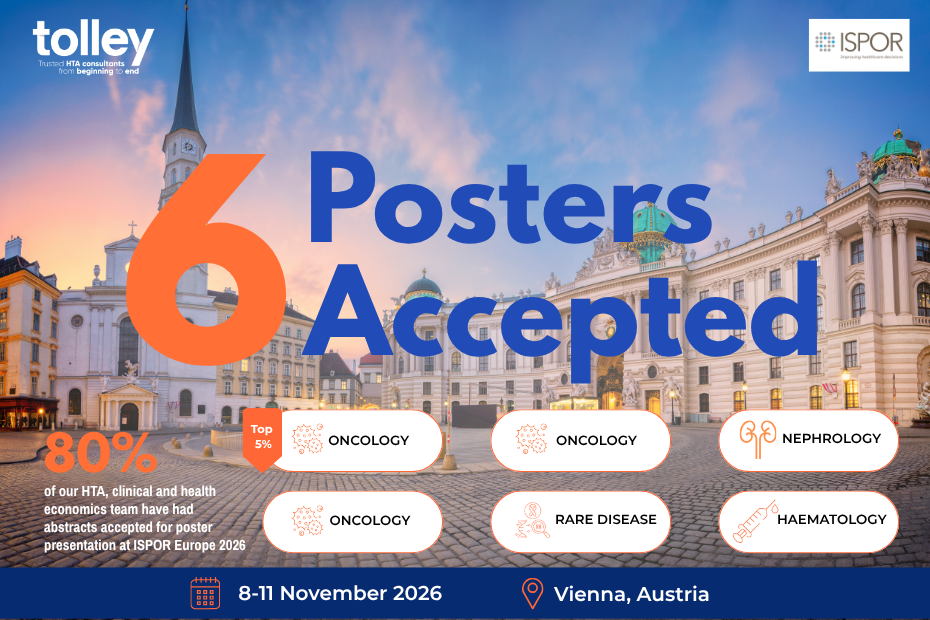
We are delighted to be joining colleagues from across the global HEOR community at ISPOR Europe 2026 in Vienna.
We are looking forward to reconnecting with clients, collaborators, and industry colleagues, while also meeting new contacts and exploring new opportunities for collaboration.
This year’s accepted posters highlight the wide-ranging expertise within the Tolley team and our commitment to generating robust evidence that supports healthcare decision-making. Covering topics across oncology, rare diseases, nephrology, haematology, patient-centred research, and HTA methodology, our research addresses some of the key challenges currently facing the HEOR community.
We are especially proud that 80% of our team members are contributing authors across these posters, highlighting the collaborative culture and scientific rigour that underpin our way of working.
Trends in Utility Values Used in NICE Technology Appraisals for Non-Small Cell Lung Cancer Over the Past Decade
Sam Riley, HTA Analyst
For patients with non-small cell lung cancer (NSCLC), disease progression after second-line treatment can significantly impact health-related quality of life (HRQoL). However, the utility values used to capture this impact within economic evaluations can vary considerably between NICE technology appraisals.
This research explores trends in utility values used across NSCLC appraisals over the last decade, examining how progression-free and progressed disease health states have been represented. By identifying areas of variation and inconsistency, the work seeks to better understand whether current approaches adequately reflect patients’ experiences and support robust, evidence-based healthcare decision-making.
Evaluating AI Versus Human-Led Inductive Thematic Analysis of Patient Interviews
Jo Noble-Longster, Head of Clinical Operations
As health technology assessment increasingly incorporates patient-centred evidence, understanding the lived experiences, preferences, and treatment burden faced by patients has never been more important.
This case study compares AI-driven qualitative analysis with traditional human-led inductive thematic analysis using patient interviews from individuals with non-muscle-invasive bladder cancer. The work investigates whether emerging artificial intelligence approaches can improve efficiency while maintaining the depth, nuance, and contextual understanding required to accurately represent patient perspectives in healthcare decision-making. The findings contribute to an important and timely discussion about the future role of AI in evidence generation and patient engagement.
Real-World Comparator Evidence for BCG-Unresponsive Non-Muscle-Invasive Bladder Cancer
Mandy Strickson, Managing Director
Generating robust comparator evidence can be particularly challenging in rare and difficult-to-study patient populations.
To support European HTA submissions for a novel bladder-sparing therapy, this study utilised real-world data from NHS England’s National Disease Registration Service (NDRS) to derive a comparator cohort of patients with non-muscle-invasive bladder cancer and carcinoma in situ undergoing radical cystectomy. The project highlights both the value of real-world evidence and the practical and methodological challenges involved in identifying, accessing, and using registry data to support indirect comparative effectiveness analyses.
EQ-5D-5L-Derived Utility Drivers of HRQoL in Hereditary Angioedema
Luke Stainer, Senior Health Economist
Hereditary angioedema (HAE) is characterised by unpredictable attacks that can have a profound effect on patients’ quality of life.
Using Phase III clinical trial data and utility values generated from the newly published EQ-5D-5L UK value set, this research explores which EQ-5D domains most strongly drive utility deficits in patients with HAE. A key feature of the study is the comparison between quantitative EQ-5D findings and qualitative patient interview data collected during the trial period. This provides valuable insight into whether existing preference-based measures are sufficiently sensitive to capture the burden that patients report experiencing in their day-to-day lives.
A Framework Approach to Assess Evidence Generation Needs for Novel Treatments in Sickle Cell Disease
Emma Prentice, Senior HTA Consultant
Developing evidence packages that are fit for HTA requires careful planning, particularly in rare diseases where evidence generation can be challenging.
This poster presents a structured framework developed around NICE submission requirements to identify evidence gaps, assess evidence readiness, and prioritise future evidence generation activities. Using sickle cell disease as a case study, the research evaluates how the framework can support the development of robust, decision-focused evidence for NICE submissions. The work also explores how health inequalities and equity considerations can be incorporated into evidence generation planning, helping to address aspects that are often underrepresented in HTA.
Economic Evidence for Tacrolimus in Kidney Transplant Recipients
Tom Snell, Head of Health Economics
Economic evaluations play a crucial role in helping healthcare systems understand the value of treatments and optimise resource allocation.
This targeted literature review was undertaken to support cost-effectiveness modelling for Envarsus®, a prolonged-release tacrolimus formulation that was not included within NICE TA481 guidance on immunosuppression following kidney transplantation. The review identified key evidence relating to economic evaluations, healthcare resource utilisation, and quality of life outcomes. Findings suggest that Envarsus® may perform differently from other prolonged-release tacrolimus formulations, particularly among fast metaboliser patients, challenging assumptions used in previous assessments and highlighting areas where further UK-based evidence generation could be beneficial.
If you are attending ISPOR Europe 2026 in Vienna, we would be delighted to meet with you. Whether you would like to discuss one of our posters, explore a potential collaboration, or learn more about Tolley’s expertise across HEOR and HTA, please get in touch to arrange a meeting with our team during the conference.